CIQTEK to Showcase High-Speed Volume EM at 2026 vEM Technology Forum
September 28, 2026
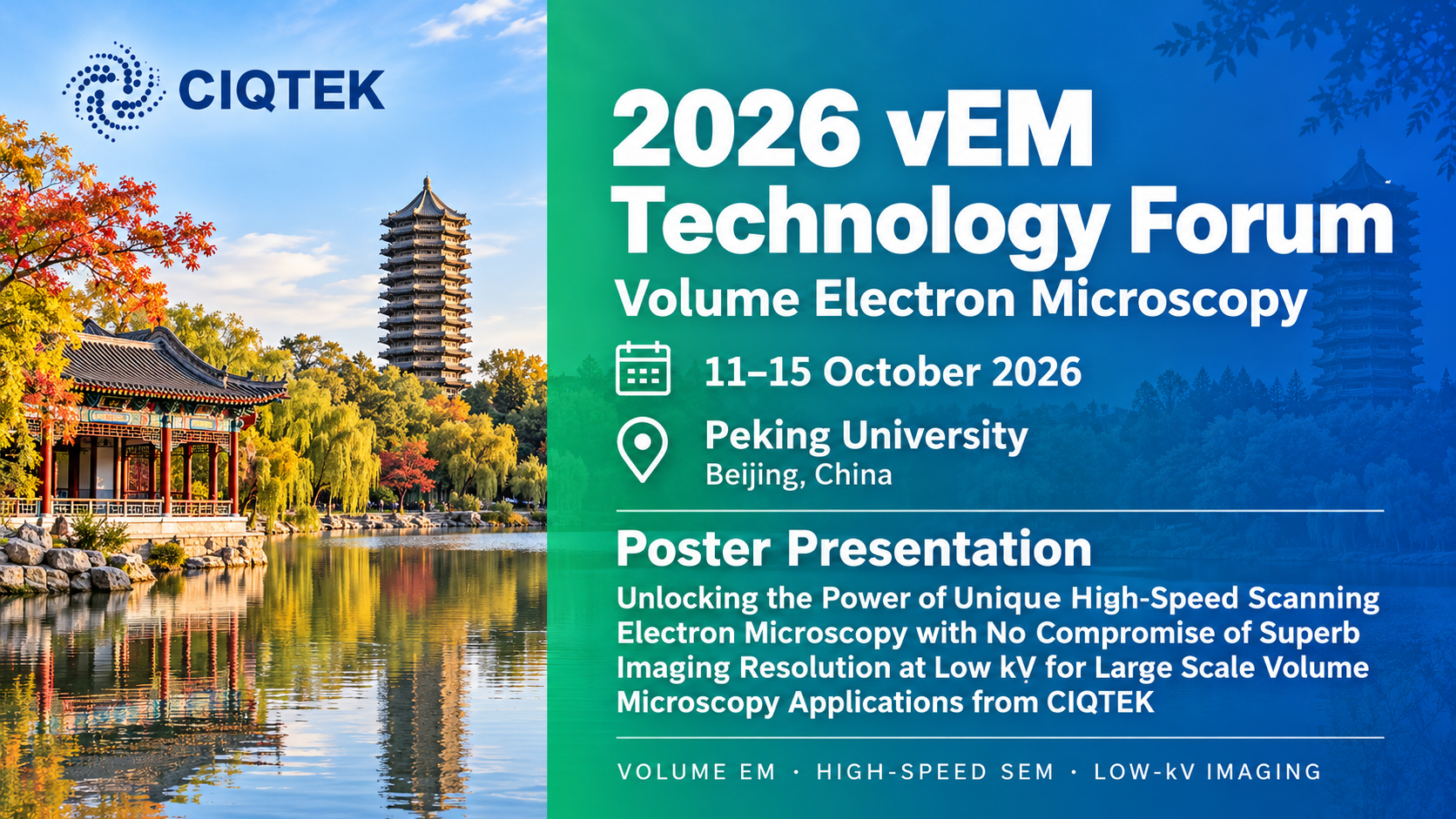
CIQTEK will join the 2026 vEM Technology Forum at Peking University in Beijing, showcasing our latest Volume Electron Microscopy (Volume EM) solutions.
Visitors can meet the CIQTEK team at our booth to explore how high-speed SEM, low-kV high-resolution imaging, automated large-area acquisition, and 3D reconstruction can help researchers handle increasingly large and complex volume microscopy datasets.
CIQTEK Poster Presentation
At the forum, Xin Ren (Luke), CIQTEK Senior Electron Microscopy Solution Manager, will present our latest work on high-speed SEM for large-scale Volume EM.
Poster Title: Unlocking the Power of Unique High-Speed Scanning Electron Microscopy with No Compromise of Superb Imaging Resolution at Low kV for Large Scale Volume Microscopy Applications from CIQTEK
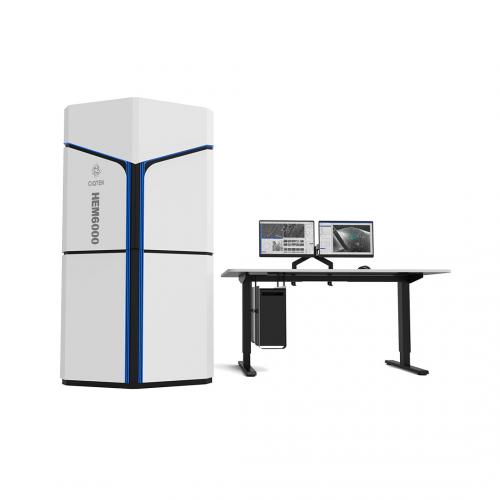
The poster will explore how the HEM6000 combines high imaging speed, strong low-kV resolution, large-area imaging, and intelligent automation to support large-scale Volume EM workflows.
Meet CIQTEK in Beijing
The 2026 vEM Technology Forum brings together researchers and microscopy experts to exchange ideas around Volume EM technologies, workflows, automation, large-scale imaging, data processing, and emerging applications.
We look forward to meeting the vEM community, sharing our latest developments, and hearing about the real imaging challenges researchers are working on.
Visit the CIQTEK booth, meet our EM team, and discover what high-speed Volume EM can bring to your research.
Date: October 11–15, 2026 Location: Peking University, Beijing, China
Ad alta velocità Emissione di campo completamente automatizzata Microscopio elettronico a scansione Postazione di lavoro CIQTEK HEM6000 tecnologie delle strutture quali il cannone elettronico a corrente a fascio largo ad alta luminosità, il sistema di deflessione del fascio elettronico ad alta velocità, la decelerazione dello stadio di campionamento ad alta tensione, l'asse ottico dinamico e l'obiettivo combinato elettromagnetico ed elettrostatico a immersione per ottenere un'acquisizione di immagini ad alta velocità garantendo al contempo una risoluzione su scala nanometrica. Il processo di funzionamento automatizzato è progettato per applicazioni come un flusso di lavoro di imaging ad alta risoluzione su ampie aree più efficiente e intelligente. La sua velocità di imaging è oltre cinque volte superiore a quella di un microscopio elettronico a scansione a emissione di campo convenzionale (FESEM).